

You're standing in your living room looking at the empty space where your mother's favorite armchair used to be, trying to imagine how a hospital bed will fit there, and wondering who pays for all the equipment that hospice mentioned on the phone. The nurse said something about oxygen, a wheelchair, maybe a bedside commode—and you're already overwhelmed before any of it arrives.
Here's what matters most: hospice equipment at home is provided at no cost under Medicare and most insurance plans, covering everything from hospital beds to oxygen concentrators delivered and set up by trained technicians. Within 24-48 hours of hospice admission, a hospice nurse will assess your loved one's needs and arrange prompt delivery of durable medical equipment (DME) related to the terminal illness. When the time comes, the hospice team will coordinate equipment pickup, usually within a few days after death, so families never have to manage logistics during grief.
What Hospice Equipment Is Delivered to Your Home
Understanding what hospice equipment will arrive at your home helps families prepare both the physical space and emotionally for this transition to comfort care at home. Not every patient needs every piece of equipment—your hospice nurse will assess what will genuinely improve comfort, safety, and quality of life for your loved one.
Hospital Beds and Pressure-Relief Mattresses
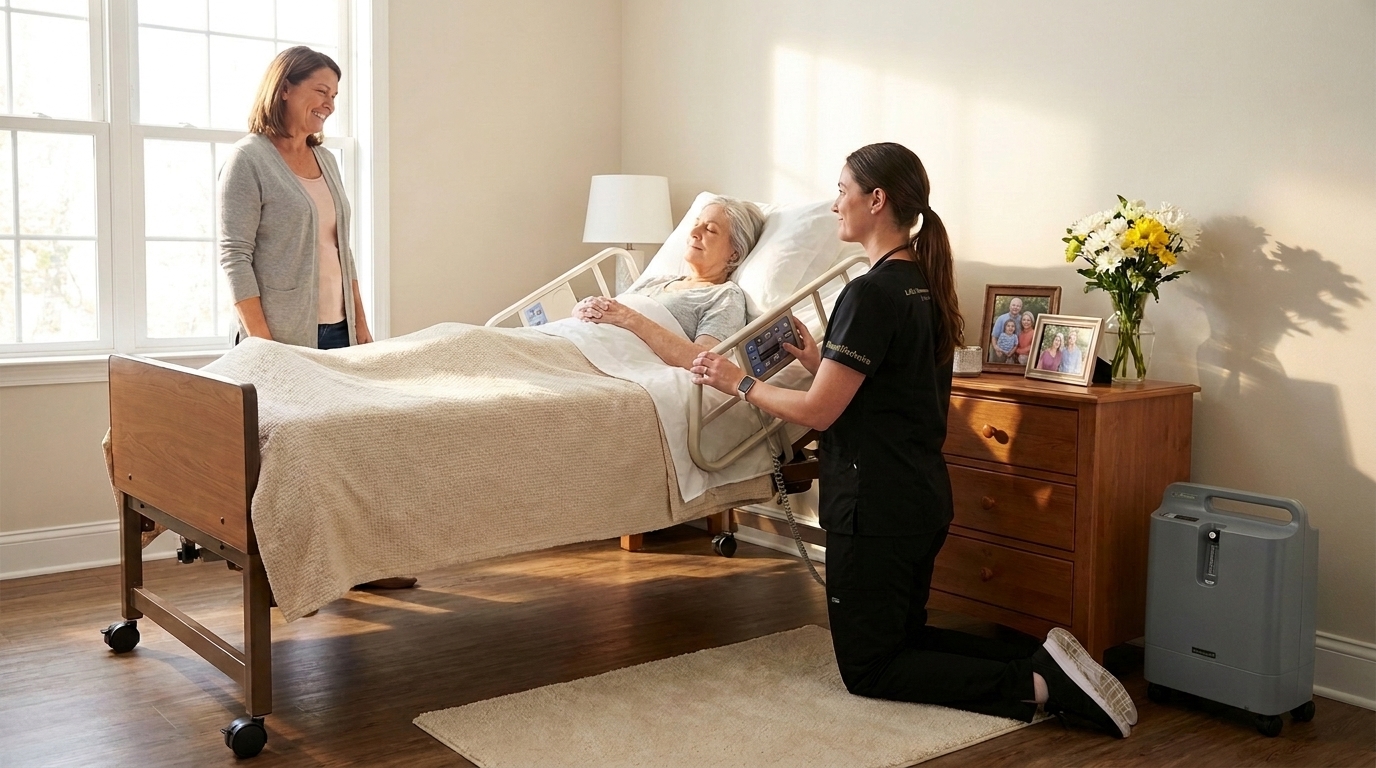
Hospital beds are the most commonly provided piece of hospice DME, and for good reason. Adjustable head and foot positioning helps with breathing, swallowing, digestion, pressure relief, and significantly reduces caregiver back strain when providing care.
Hospice typically provides semi-electric or full-electric hospital beds at no cost, with standard 36-inch width beds and bariatric options available based on patient needs. The bed rails, hand controls, and positioning features aren't just medical conveniences—they're what let your dad raise his head enough to eat breakfast without choking, or what allows you to adjust his position at 2 a.m. without waking him or hurting your back.
Pressure-relief mattresses or overlays accompany hospital beds for patients at risk of skin breakdown. These specialized surfaces distribute body weight more evenly than standard mattresses, preventing painful pressure ulcers that can develop quickly in bed-bound patients. Some are foam overlays; others use alternating air cells that gently shift pressure points throughout the night.
A daughter in Schaumburg once told us she cried with relief when the hospital bed arrived—not because her mom was sick, but because her mom could finally sleep without pain for the first time in months.
Oxygen Equipment and Concentrators
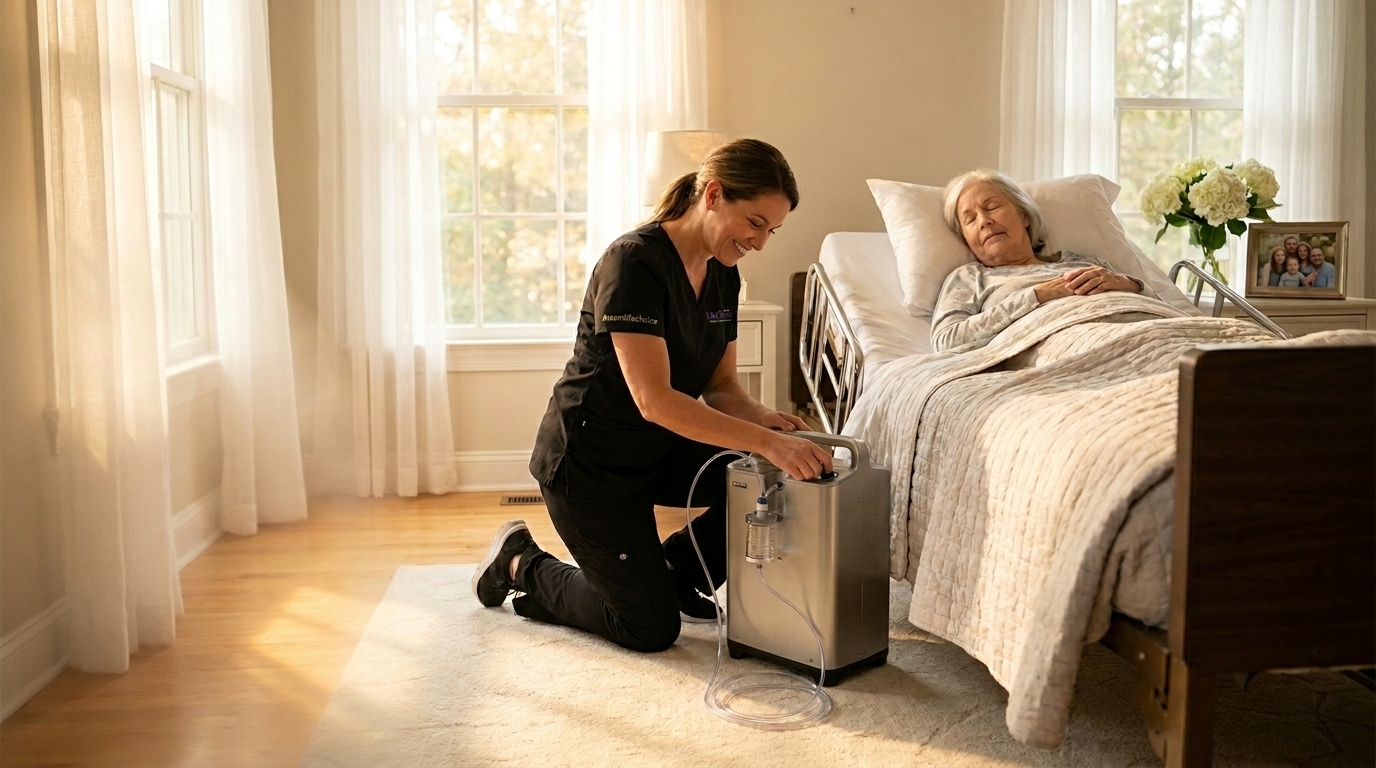
Oxygen therapy is one of the most common hospice interventions for patients with heart disease, COPD, lung cancer, or any condition that compromises breathing. Hospice provides two types of oxygen systems: stationary oxygen concentrators for use at home, and portable oxygen tanks or concentrators for mobility.
Stationary concentrators plug into a standard electrical outlet and pull oxygen from room air, eliminating the need for tank deliveries. They're quiet, reliable, and run continuously. Portable systems allow patients to move from room to room, sit outside, or take short trips while maintaining their oxygen therapy.
The DME technician will set up all tubing, demonstrate how to adjust flow rates (though your hospice nurse will determine the prescribed rate), and show you how to attach nasal cannulas or face masks. They'll also explain safety precautions around oxygen—no open flames, no smoking within ten feet, proper storage of portable tanks.
Many families worry that starting oxygen means their loved one is "giving up" or will become dependent on it. That's not how it works. Oxygen is prescribed when the body needs support to maintain comfortable oxygen levels—it relieves the exhausting work of struggling to breathe and often allows patients to participate more fully in life, not less.
Wheelchairs, Walkers, and Mobility Aids
Hospice provides wheelchairs and walkers when they improve a patient's ability to move safely or participate in meaningful activities. These aren't symbols of decline—they're tools that expand possibilities.
Standard manual wheelchairs are most common, but transport wheelchairs (lighter, with smaller wheels) are available for patients who need to be pushed rather than self-propel. Bariatric wheelchairs accommodate larger patients comfortably and safely.
Walkers come in several varieties: standard walkers without wheels, two-wheeled rolling walkers, and four-wheeled rollators with hand brakes and seats. Your hospice team will recommend the option that balances stability with your loved one's strength and mobility goals.
One family told us their father used his wheelchair to get to the backyard every afternoon to watch the birds—something he hadn't been able to do in a year. That's what mobility equipment is for: maintaining connection to what brings joy.
Bedside Commodes and Bathroom Safety Equipment
Bedside commodes allow patients to use the toilet without walking to the bathroom, which becomes critically important as strength declines. They're placed next to the bed for nighttime use or in rooms where bathroom access is difficult.
Raised toilet seats and grab bars are also covered when they prevent falls and support safe toileting. Shower chairs or benches allow patients to bathe while seated, reducing fall risk and conserving energy.
These items feel deeply personal and sometimes embarrassing to request. But hospice nurses have seen it all, and they know that safe, dignified toileting directly affects quality of life. Families consistently tell us they wish they'd asked for a bedside commode sooner—the relief of not having to help a weak, unsteady parent navigate stairs at 3 a.m. is profound.
Lift Equipment and Transfer Aids
For patients who need significant physical assistance moving from bed to chair or using the bathroom, hospice can provide patient lifts (also called Hoyer lifts) and transfer boards. These devices protect both patient and caregiver from injury during transfers.
Ceiling-mounted or floor-based mechanical lifts use a sling system to gently lift and move patients who cannot bear weight. Transfer boards create a smooth sliding surface between bed and wheelchair. Gait belts give caregivers a secure handhold when assisting with walking.
Your hospice nurse will assess whether lift equipment is appropriate and will train family caregivers on safe operation. Many families feel anxious about using mechanical lifts at first, but after proper training, most find them far safer and more dignified than attempting manual transfers that risk dropping a loved one.
When Does Hospice Equipment Get Delivered?
Speed matters when someone is struggling to breathe or can't get out of bed safely. Hospice teams understand this urgency, and equipment delivery timelines reflect it.
Initial Assessment and Equipment Ordering
Within 24 hours of hospice admission, a registered nurse will visit your home to conduct a comprehensive assessment. This includes evaluating your loved one's physical condition, home environment, safety risks, and equipment needs. The nurse will discuss what equipment would improve comfort or safety and explain what each item does.
Equipment orders are typically placed the same day as the assessment, and most items arrive within 24-48 hours. Urgent needs—like oxygen for severe shortness of breath or a hospital bed for someone at high fall risk—often receive same-day delivery.
The hospice nurse coordinates directly with durable medical equipment suppliers, so you don't have to make phone calls, compare vendors, or arrange deliveries yourself. Your job is to be present with your loved one. The logistics are handled for you.
Delivery, Setup, and Training
DME technicians deliver equipment directly to your home, carry it inside, assemble everything, and provide hands-on training before they leave. You won't be handed a box and an instruction manual—the technician will demonstrate how the hospital bed controls work, how to adjust oxygen flow, how to lock wheelchair brakes, and answer any questions.
They'll also ensure everything fits in your space and functions properly. If a hospital bed doesn't fit through a doorway or a wheelchair can't navigate your hallway width, the technician will work with the hospice team to find alternative solutions.
Most deliveries take 30-60 minutes depending on the complexity of equipment. The technician will leave contact information in case anything stops working or you have questions after they leave.
A family in Naperville told us their DME technician spent 45 minutes adjusting their mom's hospital bed until it was positioned perfectly next to the window where she could see her garden. That level of care is standard, not exceptional.
After-Hours and Weekend Delivery
Medical needs don't follow business hours. Most hospice providers, including LifeChoice, have systems in place for urgent after-hours and weekend equipment delivery. If your loved one's breathing suddenly worsens at 9 p.m. on a Saturday and the on-call nurse determines oxygen is needed, it will be delivered that night.
Non-urgent items may wait until the next business day, but anything affecting immediate safety or comfort is prioritized. Your hospice team will always communicate clearly about when to expect delivery.
Who Pays for Hospice Equipment at Home
This is the question families ask most often, and the answer brings enormous relief: you pay nothing out of pocket for hospice equipment related to the life-limiting illness.
Medicare Hospice Benefit Coverage
The Medicare hospice benefit operates differently than traditional Medicare. Instead of itemized billing for each service, Medicare pays the hospice agency a daily per-diem rate that covers everything related to the terminal diagnosis: nursing care, physician services, medications, medical equipment, supplies, and more.
All durable medical equipment related to your loved one's hospice diagnosis is included in that daily rate at no additional charge. There are no co-pays, no deductibles, no rental fees, no delivery charges. The hospice agency absorbs all equipment costs as part of providing comprehensive care.
This coverage includes hospital beds, mattresses, oxygen equipment, wheelchairs, walkers, bedside commodes, patient lifts, and any other DME the hospice team determines is necessary for comfort and safety.
Private Insurance and Medicaid Coverage
Most private insurance plans and Medicaid also cover hospice equipment at no cost to families when hospice benefits are elected. Coverage terms vary slightly by plan, but the principle remains the same: hospice equipment related to the terminal illness is covered.
Your hospice agency verifies insurance coverage during the admission process and handles all billing directly with insurers. Families are not responsible for navigating claims, denials, or reimbursement paperwork.
If you have private insurance, your hospice intake coordinator will explain exactly what's covered and whether any equipment falls outside the hospice benefit (rare, but possible for items unrelated to the hospice diagnosis).
What Families Never Pay For
Under the Medicare hospice benefit, you will never receive bills for:
- Hospital bed rental or purchase
- Pressure-relief mattress rental
- Oxygen equipment rental or oxygen supply
- Wheelchair or walker rental
- Bedside commode or bathroom safety equipment
- Patient lift equipment
- Delivery, setup, or pickup fees
- Equipment maintenance or repairs
- Replacement supplies like oxygen tubing, wheelchair cushions, or commode liners
If you receive a bill from a DME supplier for hospice equipment, do not pay it. Contact your hospice agency immediately—this is almost always a billing error that the hospice team will resolve.
Equipment Not Covered by Hospice
Hospice covers equipment related to the terminal diagnosis. Items unrelated to the hospice condition may not be covered. For example, if your loved one has been on hospice for heart failure and then fractures a hip, equipment specifically for the hip fracture might not be covered under the hospice benefit.
Similarly, some comfort items families request—like specialized recliners, video baby monitors for patient observation, or air purifiers—may not qualify as medical equipment under Medicare guidelines. Your hospice nurse will always be transparent about what is and isn't covered, and can often suggest creative alternatives.
How Equipment Pickup Works After Death
When your loved one dies, the last thing you should have to worry about is coordinating equipment returns. The hospice team handles this with sensitivity and timing that respects your needs.
Timeline for Equipment Pickup
Most hospice agencies arrange equipment pickup within 3-7 days after death, though timelines vary based on family preferences and funeral arrangements. There's no rush—the equipment can remain in your home as long as you need time to process, gather family, or prepare for services.
Your hospice nurse or bereavement coordinator will ask when would be a good time for the DME company to schedule pickup. Some families want it removed quickly because seeing the hospital bed is too painful. Others aren't ready to let go of that physical reminder for a week or more. Both responses are normal, and the timing can flex to what feels right for you.
Who Coordinates the Pickup
The hospice agency coordinates all equipment pickup with the DME supplier—you don't have to call anyone or arrange anything. The hospice team will let the DME company know that equipment is ready for retrieval, and the DME company will contact you to schedule a convenient pickup time.
If you're not comfortable being present for the pickup, you can arrange for someone else to be there, or in some cases, leave the equipment accessible in a garage or porch for retrieval. The DME company will work with whatever arrangement brings you peace.
What Gets Picked Up vs. What Stays
All durable medical equipment provided by hospice must be returned: hospital beds, mattresses, oxygen concentrators, wheelchairs, walkers, bedside commodes, patient lifts. These are expensive items that are sanitized, refurbished, and reused for other patients.
Disposable supplies do not need to be returned and can be discarded: unopened medications are typically retrieved by hospice for proper disposal, but items like incontinence supplies, wound dressings, gloves, and personal care items can be thrown away or donated if unused.
If you're unsure whether something should be returned, your hospice team will provide a clear list. The DME pickup team will also know what they're there to collect.
If Equipment Isn't Picked Up Promptly
Occasionally, DME suppliers are slow to schedule pickup. If more than two weeks pass without contact, reach out to your hospice agency—they will follow up with the supplier on your behalf. You are not responsible for storing equipment indefinitely, and you should never receive bills for "late return" or "rental extensions" after your loved one's death.
LifeChoice coordinates closely with our DME partners to ensure respectful, timely pickup that never adds burden to grieving families. If any issues arise, our bereavement team remains available to advocate for you even after your loved one has died.
Common Questions Families Ask About Hospice Medical Equipment
These questions come up in nearly every home visit, usually with a mix of practical concern and emotional weight. Here's what families across Cook, Lake, McHenry, DuPage, and Kane counties most want to know.
Does Accepting a Hospital Bed Mean My Loved One Will Never Get Out of Bed Again?
Not at all. A hospital bed doesn't confine anyone—it provides options. Many hospice patients spend part of the day in a recliner or at the kitchen table and use the hospital bed primarily for sleeping or rest periods.
The bed is a tool for comfort and safety, not a symbol of surrender. The adjustable positioning often allows patients to do more, not less—sitting upright for meals, reading with the head elevated, or sleeping in a semi-reclined position that eases breathing.
You can always decline equipment or request its removal if it's not serving your loved one well. The hospital bed isn't a one-way decision.
Will Oxygen Make My Dad Dependent or Hasten His Death?
This is one of the most persistent myths about oxygen therapy, and it causes real suffering when families delay necessary treatment out of fear. Oxygen does not create dependency, and it does not hasten death—it relieves the exhausting work of struggling to breathe when the body can't maintain adequate oxygen levels on its own.
Some patients need oxygen 24/7; others use it only during activity or sleep. The need for oxygen reflects the underlying disease process, not the oxygen itself. Starting oxygen often allows patients to feel more alert, participate more in conversation, and experience less anxiety—all signs of improved quality of life.
If your dad's oxygen levels are low, providing supplemental oxygen is a compassionate choice that aligns perfectly with hospice philosophy: maximizing comfort and function for whatever time remains.
Can We Still Take Mom Outside or to Family Events With Hospice Equipment?
Yes, and we encourage it. Hospice is about living fully, and that means continuing meaningful activities whenever possible. Portable oxygen concentrators, transport wheelchairs, and careful planning make outings achievable even for quite ill patients.
A family in Libertyville took their mother to her granddaughter's graduation using a portable oxygen tank and transport wheelchair—she told us later it was the best day she'd had in two years. These experiences are what hospice exists to make possible.
Your hospice nurse can help strategize logistics, assess whether an outing is safe, and ensure you have the equipment and supplies needed. Sometimes the answer is yes with modifications; occasionally the answer is that the physical toll would outweigh the benefit. But the question is always worth asking.
What If the Equipment Breaks or Stops Working?
Call your hospice agency immediately, any time of day or night. Hospice provides 24/7 on-call nursing support, and equipment malfunction is always considered urgent. The hospice team will contact the DME supplier to arrange repair or replacement, typically the same day.
You are never responsible for repairing or replacing broken hospice equipment—that's the DME company's responsibility. Most suppliers have after-hours technicians available for emergencies like oxygen concentrator failure or hospital bed malfunction.
If a repair can't happen immediately and the equipment is critical, a backup unit will be delivered while yours is fixed.
Do I Have to Keep All the Equipment the Hospice Suggests?
Absolutely not. Hospice is built on patient and family choice. If a piece of equipment feels intrusive, isn't being used, or doesn't align with your loved one's goals, you can have it removed at any time.
Some families accept a wheelchair "just in case" and never use it—that's fine, and you can request pickup. Other families initially decline a bedside commode out of pride, then request one two weeks later when nighttime bathroom trips become dangerous—that's also fine, and delivery will be just as prompt as the first time.
Your hospice team wants you to have what genuinely helps, not a houseful of medical equipment that makes home feel like a hospital. Open, ongoing communication about what's working and what isn't is encouraged and welcomed.
Why LifeChoice Hospice Families Trust Our Equipment Process
At LifeChoice Hospice & Palliative Care, we've built our equipment coordination process around a simple principle: families should never have to chase down wheelchairs or argue with suppliers while caring for someone they love.
Since our founding in 2018 by registered nurse Alex Roshko, we've maintained close partnerships with reliable DME suppliers who share our commitment to responsive, compassionate service. Our 98% family satisfaction rate and 4.9-star rating reflect families' confidence that when we say equipment will arrive, it arrives—set up properly, explained clearly, and backed by 24/7 support if anything goes wrong.
We serve families throughout Cook, Lake, McHenry, DuPage, and Kane counties with the same equipment coordination standards: assessment within 24 hours, delivery within 24-48 hours, and respectful, timely pickup when the time comes. Our ACHC accreditation and Medicare certification mean we meet rigorous national quality standards, but our real measure of success is simpler—families tell us the logistics just worked, so they could focus on what mattered most.
Our quality score of 80 out of 100 compared to the national average of 67 reflects outcomes that matter: pain management, symptom control, and family-reported quality of care. Part of achieving those outcomes is ensuring the right equipment arrives at the right time, works reliably, and never becomes a source of stress or confusion.
You can learn more about our equipment services at our hospice medical equipment page, or contact our team directly.
Moving Forward With Confidence
The hospital bed that will replace your mother's armchair isn't an ending—it's a tool that might let her sleep without pain, breathe more easily, and stay in the home she loves instead of returning to a facility. The oxygen concentrator humming quietly in the corner might be what allows your dad to sit on the back porch and watch the sunset instead of lying in bed struggling for air.
Hospice equipment at home is never just equipment. It's what makes the final chapter possible in the place that feels most like home, surrounded by the people who matter most. And when you work with a hospice agency that handles the coordination with competence and care, the logistics fade into the background where they belong.
If you're considering hospice care for a loved one or have questions about what equipment might be helpful, we're here to talk through your specific situation. Call us at 847-777-8888, email info@mylifechoice.org, or contact LifeChoice to speak with our intake team. You don't need to have all the answers yet—that's what we're here to help you figure out, one step at a time.