

Key Takeaways
- Hospice is not a place but a specialized philosophy of palliative care focused on comfort, dignity, and quality of life for patients with a life-limiting illness and a life expectancy of six months or less
- Most hospice care is delivered at home—approximately 98% of hospice days occur at the patient's residence, whether that's a private home, assisted living facility, or nursing home, with the hospice team bringing comfort care directly to the patient
- Hospice does work with existing facilities including nursing homes, assisted living communities, and hospitals, and can arrange short-term inpatient hospice care when symptoms require 24/7 professional management that cannot be provided at home
- Medicare covers hospice care in all settings under Medicare Part A, including routine home care, continuous care for crisis management, general inpatient care for acute symptoms, and respite care to give family caregivers a break
- Families maintain choice and flexibility—you can receive hospice at home with support close to family, transition between home and facility care as needs change, and hospice teams help coordinate care wherever the patient feels most comfortable
Understanding Where Hospice Care Takes Place: It's a Service, Not a Location
What Hospice Actually Is vs. Common Misconceptions
When people hear "hospice," they often imagine a specific building or facility—a place where their loved one would be taken away from everything familiar. This is one of the most common misconceptions about hospice care. Hospice is not a place. It's a specialized type of palliative care focusing on comfort, symptom management, and quality of life for someone with a serious illness.
Hospice medical care is provided primarily where a person lives—so the patient can be near family, friends, pets, and valued possessions. Whether that's a house in Naperville, an assisted living apartment, or a nursing facility, the hospice team brings the care to your loved one rather than requiring a move to an unfamiliar location.
Hospice is a philosophy of comfort care rather than curative treatment. It addresses physical, emotional, and spiritual needs through an interdisciplinary team approach that includes nurses, doctors, social workers, chaplains, and hospice aides—all working together to support both the patient and the family.
One of the most harmful misconceptions is that choosing hospice means "giving up." The truth is exactly the opposite. Hospice is for people who want to live as long and as well as possible. Research consistently shows that hospice patients with certain diagnoses—including congestive heart failure, lung cancer, and pancreatic cancer—lived an average of 29 days longer than similar patients who continued aggressive treatment. Hospice doesn't hasten death. It stops treatments that are causing suffering without meaningful benefit, while continuing medications and care that support comfort, function, and quality of life.
The six-month prognosis is not a death sentence or a firm deadline. It's a medical estimate based on the typical progression of an illness. Many hospice patients live longer than six months, and Medicare coverage continues as long as the patient remains eligible and the hospice physician recertifies their condition.
The Four Levels of Hospice Care and Where Each Occurs
Medicare defines four distinct levels of hospice care, each designed to meet changing patient needs. Understanding these levels helps families know what support is available and where care happens.
Routine home care represents approximately 98% of all hospice days. This is the most common level, provided wherever the patient calls home—private residence, nursing home, assisted living community, or residential care facility. The hospice team visits on a schedule, typically with nurses coming 1-3 times per week and aides 2-3 times per week. Patients have 24/7 phone access to a nurse, and all medications, medical equipment, and supplies related to the hospice diagnosis are provided. Family members or paid caregivers provide most day-to-day care, with training and support from the hospice team.
Continuous home care accounts for less than 1% of hospice care but becomes crucial during a medical crisis. When a patient experiences severe pain, breathing difficulty, agitation, or other uncontrolled symptoms, hospice can provide intensive nursing care in the patient's home for extended periods—at least 8 consecutive hours in a 24-hour period, and up to 24 hours if medically necessary. The goal is to stabilize symptoms and avoid hospitalization, keeping the patient in their familiar environment. Once the crisis passes, care returns to routine home care.
General inpatient care is provided when pain or symptoms cannot be managed at home, even with continuous care and family support. The patient moves temporarily to an inpatient setting—a hospital, hospice inpatient facility, or skilled nursing facility—where they receive 24-hour professional care focused on stabilizing severe symptoms. This level accounts for less than 1% of hospice days. The goal is always to control symptoms so the patient can return home when possible, though some patients do remain in inpatient care through the end of life.
Respite care gives family caregivers a much-needed break. The patient stays in a Medicare-approved facility for up to five consecutive days while the primary caregiver rests, attends to other responsibilities, or simply prevents burnout. This can be arranged as often as needed throughout the hospice journey. Respite care also accounts for less than 1% of hospice days, but it serves a vital purpose in supporting family caregivers through what can be an exhausting time.
Where Most Hospice Patients Receive Care: The Home Setting Explained
"Home" Can Mean Many Different Places
When hospice teams talk about "home care," they're describing care provided wherever the patient lives—not necessarily a traditional house. Home can be an apartment, a condo, a room in an adult child's house, an assisted living community, a memory care unit, or a nursing facility.
A daughter in Gurnee once told us she worried her mother's small apartment wouldn't work for hospice. She was relieved to learn that hospice comes to any residence. The hospice team arranged for a hospital bed, managed her mother's medications, and provided all the support they needed—no facility required.
What matters is that the patient is in a familiar, comfortable environment surrounded by the people and things they love. This is where hospice delivers approximately 98% of all care, because being home—whatever that means for your family—makes an enormous difference in quality of life.
What "At-Home" Hospice Care Actually Looks Like Day-to-Day
Many families imagine that choosing hospice means being left alone to handle everything. The reality is quite different. When you choose home hospice, you gain an entire team of professionals who come directly to you.
Here's what routine home care typically includes:
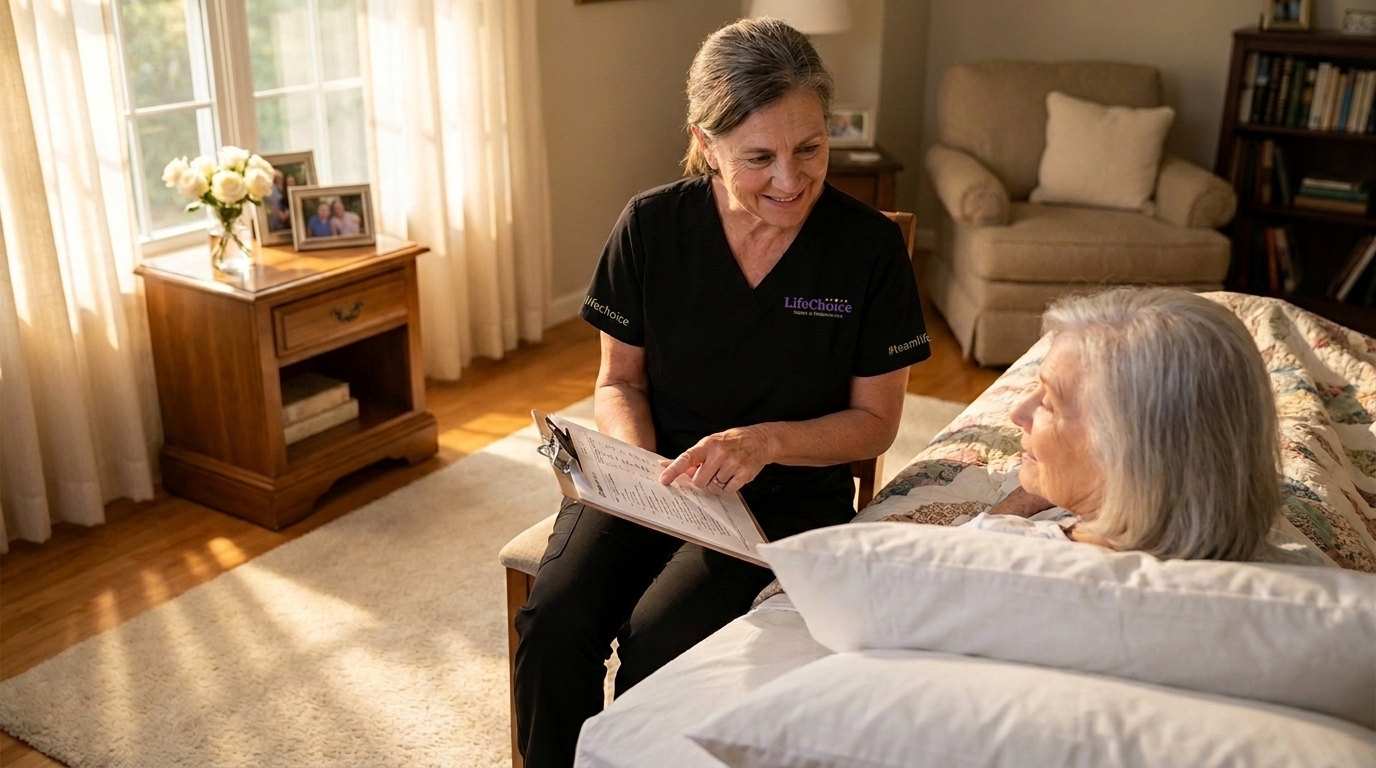
Scheduled visits from your hospice team. Your registered nurse (usually called your case manager) visits 1-3 times per week to assess symptoms, adjust medications, monitor the patient's condition, and provide medical care. A hospice aide visits 2-3 times per week to help with bathing, dressing, grooming, and personal care. A social worker visits once or twice per month to help with emotional support, advance directives, benefit coordination, and family dynamics. A chaplain offers spiritual support if desired, visiting as often or as rarely as the family requests.
24/7 access to a nurse by phone. You're never alone. Day or night, weekends and holidays, you can call and speak directly to a registered nurse who has access to your loved one's care plan and can provide guidance, reassurance, or arrange an immediate visit if needed.
All medications related to the hospice diagnosis. Pain medications, anti-nausea medications, anti-anxiety medications, breathing treatments—whatever is needed for comfort care—are delivered directly to your home, usually within 24 hours.
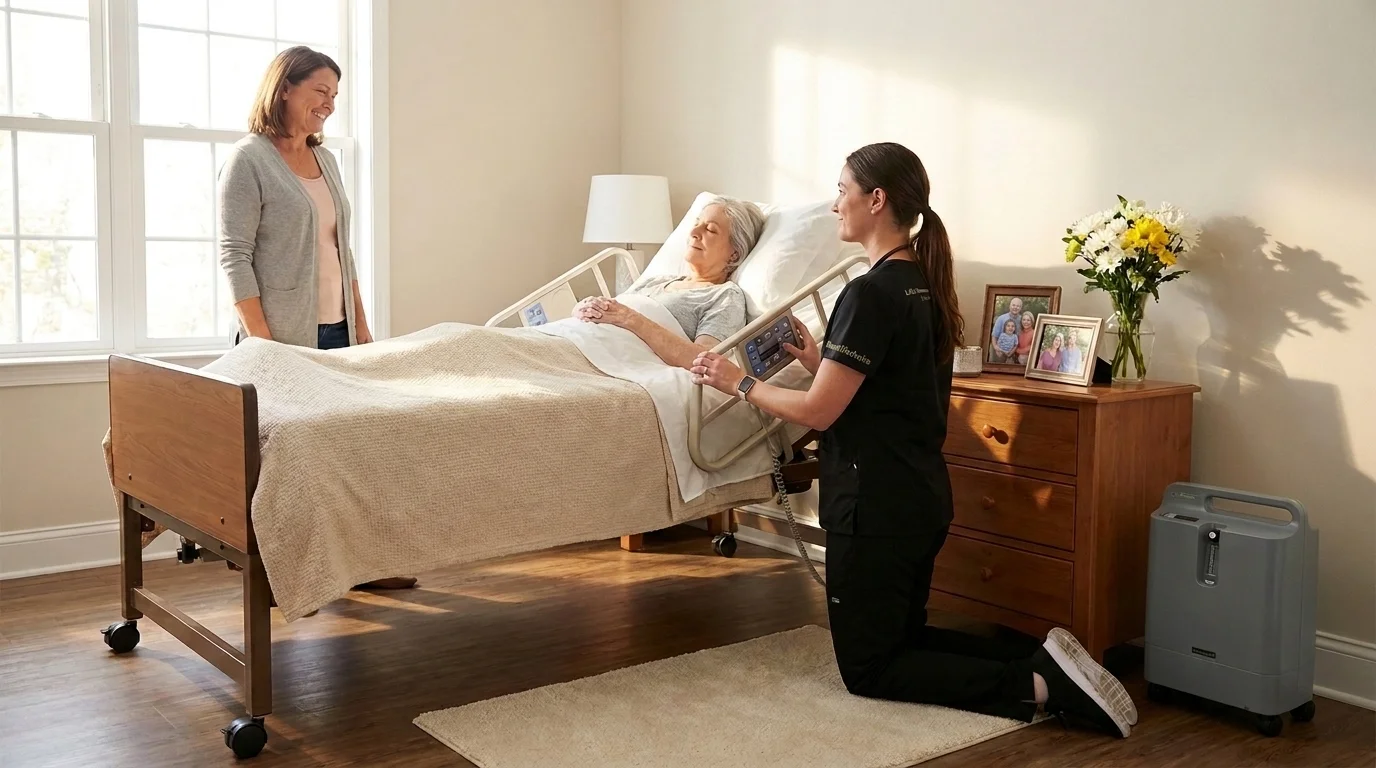
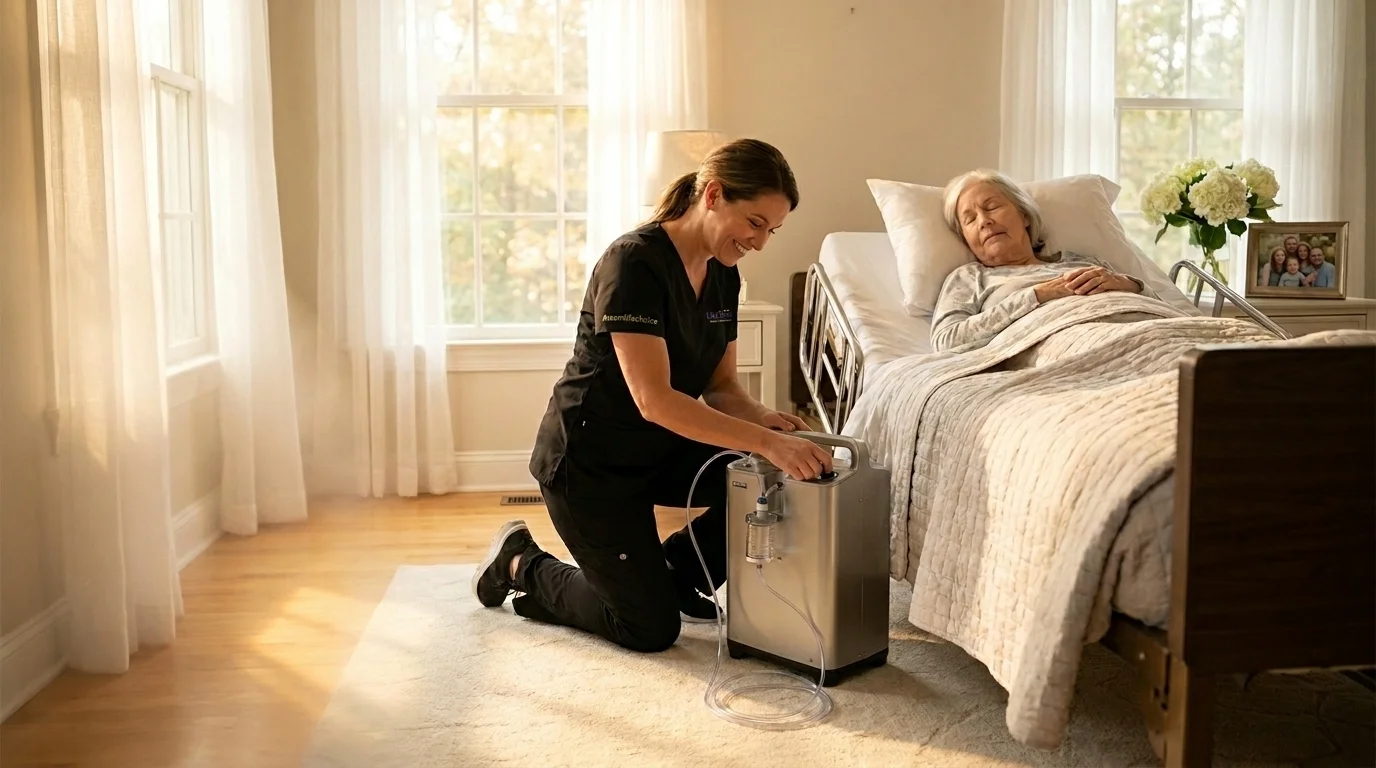
Medical equipment and supplies. Hospital beds, wheelchairs, walkers, oxygen equipment, incontinence supplies, wound care supplies—all provided and set up in your home at no cost to you. When you call us, equipment usually arrives the next day, because we know that a hospital bed isn't just equipment. It's what lets your mom sleep through the night for the first time in weeks.
Crisis support when you need it. If symptoms spiral—if pain becomes uncontrolled or breathing becomes severely labored—your hospice team can immediately escalate to continuous home care, bringing a nurse to your home for 8+ hours to stabilize the situation and keep your loved one comfortable at home.
This level of support makes home care possible even for families who initially think they can't handle it. You're not doing this alone.
Why Home-Based Hospice Care Works So Well for Families
There's a reason nearly all hospice care happens at home: it works better for almost everyone involved.
Patients report feeling safer, more comfortable, and more like themselves when they're in their own space. They can sleep in their own bed (or a hospital bed positioned where they want it), eat what they want when they want it, see their grandchildren whenever the family visits, and have their dog curled up beside them. These things sound small, but they represent autonomy, dignity, and normalcy during a time when so much feels out of control.
Family members describe being able to truly be present in a way that's impossible in a hospital or facility. Instead of visiting during restricted hours, sitting in uncomfortable chairs, and navigating institutional rules, you're living life together. You're making breakfast, watching favorite shows, looking through old photo albums, and having conversations that matter—not just visiting, but sharing life in the last chapter.
Studies show that patients who receive hospice at home use fewer aggressive interventions, experience better symptom control, and report higher satisfaction with their care. Families consistently rate home hospice as providing better quality of life than hospital or facility-based end-of-life care.
From a practical standpoint, home-based palliative care also helps families avoid the financial burden of room and board in a facility. Medicare covers all hospice services under Medicare Part A, but it does not cover the cost of housing—whether that's in a nursing home, assisted living, or a hospice residential facility. When care happens at home, there's no separate room-and-board charge to navigate.
When Hospice Care Happens in Facilities: Nursing Homes, Assisted Living, and Inpatient Units
Hospice in Nursing Homes and Assisted Living Communities
If your loved one already lives in a nursing home or assisted living community when they become eligible for hospice, they don't need to move. The hospice team comes directly to the facility and provides care right there.
This is a common scenario, especially for older adults with multiple chronic conditions or advanced dementia. In fact, according to recent data, approximately 36% of hospice patients receive care in nursing homes or assisted living facilities.
Here's how it works: The hospice team coordinates with the facility's staff to develop a comprehensive care plan. The hospice provides all services related to the terminal diagnosis—nursing visits, medications, medical equipment, spiritual support, and family counseling. The facility continues to provide room, board, and assistance with daily activities not covered by hospice.
Medicare covers the hospice services (nursing care, medications, equipment, etc.) but does not cover the facility's room and board charges. Families continue to pay the nursing home or assisted living fees separately, often through private payment, long-term care insurance, or Medicaid.
This arrangement gives patients the benefit of both worlds: 24-hour supervision and assistance with daily living from the facility staff, plus specialized comfort care and symptom management from the hospice team.
What Inpatient Hospice Facilities Are and When They're Used
Inpatient hospice facilities—sometimes called hospice houses or hospice centers—exist for situations where symptoms cannot be managed at home even with continuous care, or when the home environment isn't safe or suitable for the level of care needed.
These facilities provide 24-hour nursing care in a homelike environment designed specifically for hospice patients and their families. Unlike hospitals, which focus on treatment and cure, inpatient hospice facilities focus entirely on comfort, dignity, and family support.
General inpatient care is used when a patient experiences:
- Severe, uncontrolled pain requiring frequent medication adjustments and close monitoring
- Respiratory distress that cannot be managed at home
- Uncontrolled nausea, vomiting, or other distressing symptoms
- Complex medical needs requiring continuous professional assessment
- Severe agitation, confusion, or behavioral symptoms that are unsafe at home
- Situations where family caregivers are unable to provide the necessary level of support
The stay is typically short-term—a few days to a week or two—with the goal of stabilizing symptoms so the patient can return home. Some patients, however, remain in inpatient care through the end of their life if returning home isn't possible or if the family chooses inpatient care as the most comfortable option.
Inpatient hospice facilities typically offer private or semi-private rooms, flexible visiting hours (often 24/7), comfortable spaces for families to stay overnight, kitchens where families can prepare meals, and peaceful environments designed to feel as homelike as possible.
Short-Term Respite Care: Giving Family Caregivers a Break
Caring for someone receiving hospice care at home is one of the most meaningful things a family can do—and one of the most exhausting. That's where respite care becomes essential.
Respite care allows the patient to stay in a facility for up to five consecutive days while the primary caregiver rests. This isn't because the patient's condition has worsened or because they need more intensive medical care. It's specifically designed to give family caregivers time to recover.
Medicare covers respite care with a small copayment (5% of the Medicare-approved cost, typically around $10 per day). The patient receives excellent 24-hour care in a hospice facility, hospital, or nursing home, while the caregiver has time to sleep, attend to personal health needs, spend time with other family members, or simply rest.
Many families resist using respite care because they feel they should be able to handle everything, or they feel guilty stepping away. But hospice teams encourage it because caregiver burnout is real, and taking care of yourself isn't selfish—it's necessary for being able to continue providing care and being emotionally present.
Respite care can be arranged as often as needed throughout the hospice journey, making it possible for families to sustain home care for much longer than they could without breaks.
How Medicare Covers Hospice in All Settings
Medicare Part A: The Foundation of Hospice Coverage
One of the most important things families need to know is that Medicare covers hospice care fully under Medicare Part A, regardless of where the care is provided.
To qualify for the Medicare hospice benefit, three conditions must be met:
- The patient must be enrolled in Medicare Part A (hospital insurance)
- A hospice physician and the patient's attending physician must certify that the patient has a life expectancy of six months or less if the illness follows its typical course
- The patient must elect the hospice benefit and agree to focus on comfort care rather than curative treatment for the terminal diagnosis
Once these conditions are met, Medicare covers 100% of hospice services related to the terminal diagnosis and any related conditions. This includes:
- All nursing care and physician services
- All medications for pain management and symptom management (with a small copay of up to $5 per prescription)
- All medical equipment and supplies
- Home health aide and homemaker services
- Physical, occupational, and speech therapy as needed
- Social work services and counseling
- Spiritual counseling and support
- Dietary counseling
- Short-term inpatient care for symptom management
- Respite care (with a 5% copay, typically around $10 per day)
- Bereavement counseling for family members for up to 13 months after the patient's death
What Medicare Does and Doesn't Cover for Hospice Patients
While Medicare provides comprehensive coverage for hospice services, it's important to understand what is and isn't included.
Medicare DOES cover:
- All four levels of care (routine home care, continuous home care, general inpatient care, and respite care)
- Care provided at home, in nursing facilities, in assisted living communities, or in inpatient hospice facilities
- All medications related to comfort and symptom management
- All medical equipment and supplies related to the hospice diagnosis
- Care that continues indefinitely as long as the patient remains eligible and is recertified
Medicare DOES NOT cover:
- Room and board charges in nursing homes, assisted living facilities, or hospice residential facilities (these must be paid separately through private payment, long-term care insurance, or Medicaid)
- Curative treatment for the terminal illness (though patients can revoke hospice at any time if they wish to pursue curative treatment)
- Medications or treatments unrelated to the terminal diagnosis (though these may be covered under regular Medicare Part B)
Coverage continues beyond six months. If your loved one lives longer than the initial six-month prognosis, Medicare coverage doesn't stop. The hospice physician simply recertifies eligibility at regular intervals (two 90-day periods followed by unlimited 60-day periods), and coverage continues as long as the patient remains eligible.
This means families can choose hospice without fear of running out of coverage or facing unexpected bills.
Medicare Advantage Plans and Hospice Coverage
If your loved one has a Medicare Advantage plan (also called Medicare Part C) instead of original Medicare, hospice coverage works slightly differently—but the bottom line is the same: hospice is fully covered.
When a Medicare Advantage enrollee elects hospice, the hospice benefit is administered through traditional Medicare Part A, not through the Advantage plan. The hospice provider bills Medicare directly. However, the patient remains enrolled in their Medicare Advantage plan, which continues to cover any extra benefits not related to the hospice diagnosis (such as dental, vision, or other supplemental services).
Families with Medicare Advantage plans should notify their plan when enrolling in hospice, but they don't need to disenroll or switch to original Medicare. The hospice team coordinates all of this to ensure seamless coverage.
Comparing Your Options: Choosing Between Home-Based and Facility-Based Hospice Care
Questions to Ask When Making the Decision
The decision about where to receive hospice care is deeply personal and depends on many factors unique to your family's situation. Here are the key questions to consider:
Can symptoms be managed at home with scheduled visits and 24/7 phone support? For most patients, the answer is yes. With the right medication management, equipment, and hospice team support, even complex symptoms can be controlled in a home setting.
Is there a family member or paid caregiver available to provide basic care between hospice visits? Hospice teams provide professional medical care, but someone needs to be present to assist with meals, medications, and basic comfort measures between visits. This could be a family member, friend, or hired caregiver.
Does the home environment feel safe and comfortable? This includes physical safety (can we get a hospital bed in the right room, are there stairs that are hard to navigate) and emotional comfort (does the patient feel peaceful and supported at home).
What level of medical intervention does the patient want? Some patients and families prefer the reassurance of 24-hour professional presence, while others strongly prefer the intimacy and autonomy of home.
How is the primary caregiver holding up? Honest assessment of caregiver capacity—physical, emotional, and mental—is essential. Respite care can help, but if home caregiving isn't sustainable, facility-based care may be the better choice.
What does the patient want? Above all, this is the patient's choice. Many patients have strong feelings about where they want to be, and honoring those wishes whenever possible is a gift.
How Families Can Transition Between Settings as Needs Change
One of the most valuable aspects of hospice care is its flexibility. Families aren't locked into one setting or one level of care. As the patient's condition changes, the location and intensity of care can adjust.
A common journey might look like this:
- Weeks 1-8: Routine home care with scheduled visits and good symptom control
- Week 9: A crisis with severe pain triggers continuous home care for 48 hours
- Week 10: Return to routine home care after symptoms stabilize
- Week 12: Caregiver exhaustion leads to five days of respite care in a facility
- Weeks 13-16: Return home with renewed caregiver energy and continued routine care
- Week 17: Symptoms become unmanageable at home, prompting a transfer to general inpatient care for intensive symptom management
This flexibility means families don't have to predict what they'll need weeks or months from now. The hospice team assesses needs continuously and adjusts the care plan accordingly.
Transitions are coordinated by the hospice team, who handle all the logistics—arranging facility placement, transporting medical equipment, coordinating with facility staff, and ensuring continuity of care. Families don't navigate this alone.
What LifeChoice Hospice Offers: Local, Compassionate Palliative Care in the Chicago Area
Our Approach to Home-Based and Facility-Based Hospice
At LifeChoice Hospice & Palliative Care, we've been serving families across Cook, Lake, McHenry, DuPage, and Kane counties since 2018. Founded by registered nurse Alex Roshko, our organization was built on a simple belief: hospice is not about giving up. It's about choosing to live fully, with dignity and support, in whatever time remains.
We provide all four levels of hospice care, wherever you need us. Whether you're at home in Schaumburg, in an assisted living community, or in a nursing facility, our team comes to you. We coordinate with inpatient facilities when general inpatient care or respite care is needed, always working toward the goal of returning patients home when that's what they want and when it's medically possible.
Our families consistently rate us at 4.9 stars, with a 98% satisfaction rate. We're ACHC accredited and Medicare certified, with a Quality Score of 80 out of 100—significantly higher than the national average of 67.
What sets us apart is our commitment to treating every patient as a whole person, not just a diagnosis. We don't automatically stop all medications when someone chooses hospice. We stop treatments that are causing suffering without benefit, while continuing medications that support function, comfort, and quality of life. We don't see the six-month prognosis as a countdown—we see it as an opportunity to make every remaining day as meaningful as possible.
Hospice Medical Equipment and Support Available at Home
One of the most common concerns families have is whether they'll have what they need to care for their loved one at home. The answer is always yes—because the hospice team provides it.
Through our hospice medical equipment services, we deliver and set up everything needed for safe, comfortable care at home:
- Hospital beds with pressure-relieving mattresses to prevent bedsores and allow easy positioning
- Wheelchairs, walkers, and transfer equipment to help with mobility and safety
- Oxygen equipment including concentrators, portable units, and all necessary supplies
- Commodes, shower chairs, and other bathroom safety equipment
- Medication dispensers and management tools
- Wound care supplies, incontinence supplies, and personal care items
Equipment is typically delivered within 24 hours of the request, and our team sets everything up and teaches families how to use it safely. If something isn't working or if needs change, we adjust immediately.
This support makes home care accessible to families who initially thought they didn't have the resources or capability to provide care at home. You don't need to own special equipment or transform your home into a medical facility. We bring what's needed, when it's needed.
Serving Families Across Cook, Lake, McHenry, DuPage, and Kane Counties
Whether your family is in Elgin or a quiet suburb, our team drives directly to your home. We serve the entire Chicago area, covering five counties with the same level of care and support.
Our local presence means we respond quickly. When you call with a concern, we don't route you to a call center in another state. You speak with a nurse who knows your area, knows your loved one's care plan, and can arrange a visit the same day if needed.
Families tell us—sometimes years later—that those months on hospice were the most present, most meaningful time they ever had together. That's what we're here to make possible.
Frequently Asked Questions About Hospice Care Locations and Settings
Does hospice care have to be provided in a facility, or can it be at home?
Hospice care is overwhelmingly provided at home—approximately 98% of all hospice days happen wherever the patient lives. This could be a private house, an apartment, an assisted living community, a nursing home, or any other residence. The hospice team comes to you, bringing all the medical care, equipment, and support needed. Inpatient hospice facilities exist for situations requiring 24-hour professional care that cannot be provided at home, but most families receive all their hospice care in their own home with scheduled visits and 24/7 phone support.
What is the difference between palliative care and hospice care?
Palliative care is specialized medical care focused on providing relief from symptoms and stress of a serious illness, and it can be provided at any stage of illness alongside curative treatment. Hospice is a specific type of palliative care provided when a patient has a life expectancy of six months or less and chooses to focus on comfort rather than curative treatment. All hospice is palliative care, but not all palliative care is hospice. Both emphasize quality of life, symptom management, and whole-person support, but hospice represents the final chapter of palliative care when the focus shifts entirely to comfort and dignity.
Does Medicare cover hospice care if my loved one is in a nursing home?
Yes. Medicare Part A covers all hospice services regardless of where the patient lives, including nursing homes and assisted living facilities. The hospice team provides all care related to the terminal diagnosis—nursing visits, medications, equipment, counseling, and support—while the facility continues to provide room, board, and assistance with daily activities. Medicare covers the hospice services at no cost to you (other than small copays for medications and respite care), but Medicare does not cover the nursing home's room and board charges. You continue to pay those fees separately through private payment, long-term care insurance, or Medicaid if you qualify.
Can my family switch from home hospice to facility care if it becomes too difficult?
Absolutely. Hospice care is designed to be flexible and responsive to changing needs. If home care becomes overwhelming or if symptoms require more intensive management, your hospice team can arrange a transition to inpatient care—either short-term for symptom stabilization (general inpatient care) or for caregiver relief (respite care). These transitions are coordinated by the hospice team, and Medicare covers all settings under the same hospice benefit. Many families move between home and facility care multiple times as needs change, and that's completely normal and supported.
What happens if my loved one in hospice wants to go to the hospital?
This depends on the reason for the hospitalization. If the hospital visit is related to the terminal diagnosis, it must be arranged and approved by the hospice team to remain covered under the hospice benefit. Hospice focuses on comfort care rather than curative treatment, so hospitalizations for aggressive interventions generally aren't part of the hospice care plan. However, if the hospital visit is for a health issue unrelated to the terminal diagnosis (for example, a broken bone from a fall), regular Medicare Part A or Part B would cover that separately. Your hospice team helps families navigate these decisions and ensures you understand your options. Patients can also choose to temporarily revoke hospice to pursue treatment and then re-enroll later if desired.
Ready to Learn More About Your Hospice Care Options?
If you're considering hospice for your loved one and wondering where care will take place, we're here to answer every question and walk you through your options. At LifeChoice Hospice & Palliative Care, we believe hospice is a gift—a choice to focus on living fully, comfortably, and meaningfully, surrounded by the people and places you love.
Our team serves families across Cook, Lake, McHenry, DuPage, and Kane counties, providing compassionate, expert hospice care wherever you call home. We'd be honored to support your family through this journey.
Call us at 847-777-8888 to speak with a hospice specialist, or email us at info@mylifechoice.org. You can also contact LifeChoice through our website to schedule a consultation and learn more about how we can support your family with palliative care that honors your loved one's wishes and brings comfort to everyone involved.